- announces the official release of Shader Model 6.9, introducing Long Vector support, 16-bit float specials, and making 16-bit/64-bit shader ops and wave ops required features
- brings DXR 1.2 features (Opacity Micromaps and Shader Execution Reordering) out of preview
- introduces D3D12 improvements, including revised resource view creation APIs and CPU timeline query resolves
- releases preview features, including Fence Barriers for fine-grained GPU synchronization

- introduces Opacity Micromaps (OMMs) as part of DXR Tier 1.2 to reduce overhead from redundant any-hit shader invocations for alpha-tested geometry
- encodes opacity information using masks on uniformly subdivided meshes laid out on a barycentric grid
- stores OMMs separately from bottom-level acceleration structures, allowing reuse across multiple BLASes

- introduces Fence Barriers Tier-1 in preview
- provides SignalBarrier and WaitBarrier operations for command-list scoped fences, offering a cleaner alternative to split barriers
- enables cross-queue synchronization through SignalBarrier with traditional queue-level waits
- next iterations Tier-2 will add full cross-queue WaitBarrier support

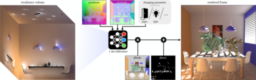
- presents Neural Irradiance Volume (NIV), a technique that replaces traditional probe grids with a compact neural model for pre-computing diffuse global illumination
- demonstrates quality improvement over probe-based methods at equivalent memory budgets while working within strict real-time constraints without requiring ray tracing or denoising
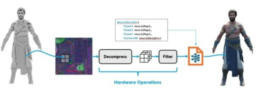
- describes the implementation of neural texture compression that uses a latent representation shared across all material channels
- explicitly models BC compression during training to ensure the network is optimized against the exact signal sampled by the renderer at runtime
- achieves approximately 30% memory reduction
- NVIDIA GTC is starting March 16 – attend virtually for free.
- Presenting the latest breakthroughs in generative AI, accelerated computing, simulation technology, and more.
- My top sessions: OpenUSD Crash Course (DLIW82272), Fundamentals of GPU-Accelerated Workflows (DLIW82265) and more
- Win an RTX Pro 6000 GPU and see my full session recommendations here
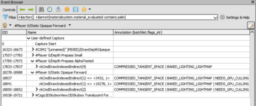
- introduces a new custom annotation system that enables rich context information on a per-event or per-object basis
- adds a shader viewer panel showing where debug symbols were loaded from and the paths searched, with support for embedding symbols within captures
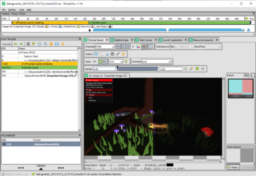
- explains how to use Vulkan’s Debug Printf feature using VK_KHR_shader_non_semantic_info
- covers implementation in GLSL (debugPrintfEXT), HLSL/Slang (standard printf), and direct SPIR-V instructions, with output viewable in RenderDoc 1.14+ or through Validation Layers
- describes format string restrictions, including limited specifiers, vector support, and limitations
- presents a new tutorial that builds on the Core Vulkan Tutorial to guide developers through more advanced concepts
- addresses aspects such as debugging, profiling, CI/CD, and packaging
- additionally covers dynamic rendering, timeline semaphores, and engine design aspects

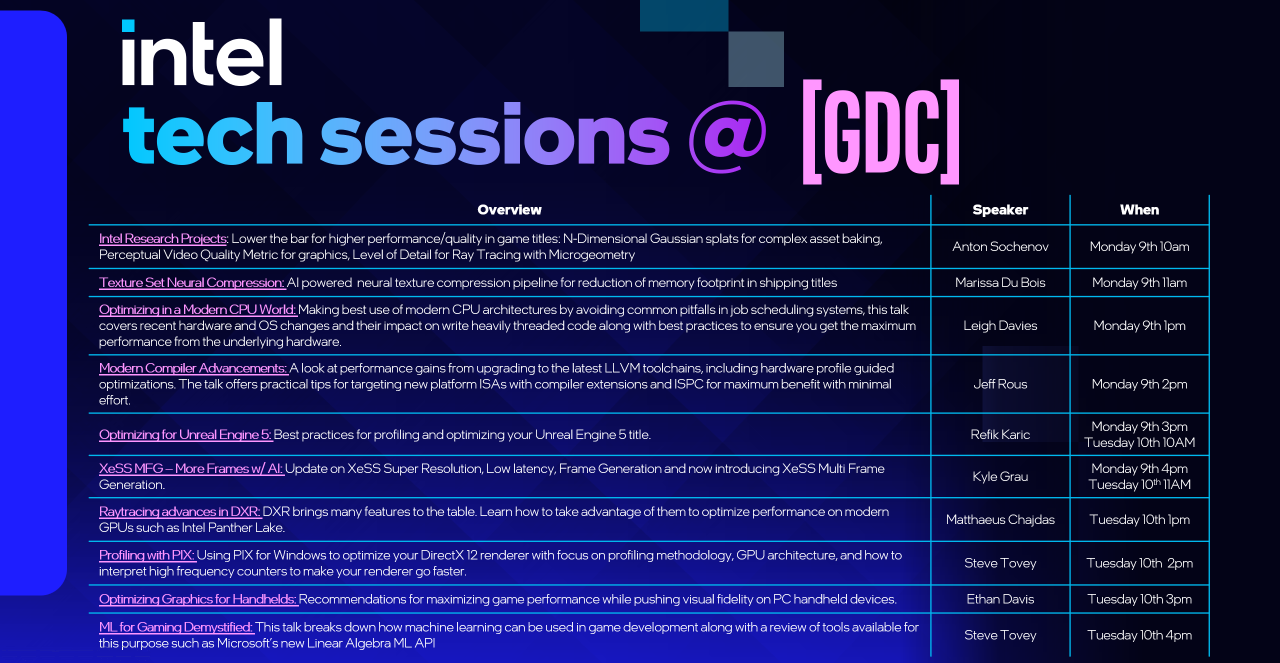
Intel will be at GDC in San Francisco (9–13 March), and we’re hosting a series of public technical talks for game developers at the AMA Center in the Marriott Marquis — just a short walk from the main conference.
Each session runs about 30–40 minutes and is designed to be interactive and informal. Expect real technical deep dives, live discussion, and plenty of time for questions — jump in, challenge us, share your experience. We’re aiming for useful conversations, not slide marathons.
If you’re around, we’d love to see you there! Click the link and register for the session(s) you’re interested in.
- presents implementation strategies for GPU-driven rendering pipelines optimized for Meta Quest 2 and Quest 3 mobile VR hardware
- discusses techniques for reducing CPU overhead and maximizing GPU utilization within the power and thermal constraints
- covers Vulkan API features that enable efficient indirect drawing and compute-heavy rendering approaches
- introduces Gigi as a rapid prototyping platform for graphics rendering research and development, designed to accelerate experimentation workflows
- demonstrates approaches for streamlining graphics programming iteration cycles and enabling faster testing of rendering algorithms and shader techniques
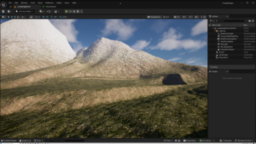
- demonstrates creating an advanced terrain auto material combining angle blend, height blending, and altitude blending for realistic surface variation
- provides implementation patterns applicable to both Unreal Engine material graphs and Unity shader graphs
Thanks to Graham Wihlidal for support of this series.
Would you like to see your name here too? Become a Patreon of this series.
