- explores the behavior of floor and ceil functions when dealing with denormalized floats
- discusses how different platforms (CPU vs. GPU) handle denormals, with some flushing to zero and others preserving them
- provides an HLSL implementation for deterministic implementations that behave consistently across devices
- proposes an algorithm for reconstructing polygonal meshes from Signed Distance Function (SDF) data
- utilizes quadratic optimization for vertex placement within grid cells to recover sharp features
- The method operates without requiring gradient information or access to the underlying function

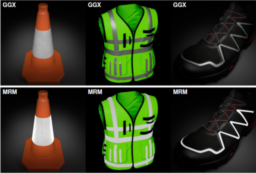
- presents a PBR retroreflective model that can be applied to any existing microfacet BSDF
- features a simple substitution method that has been integrated into OpenPBR and MaterialX
- provides mathematical proof for reciprocity and energy conservation, validated against real-world material measurements
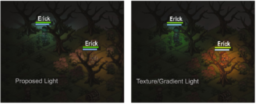
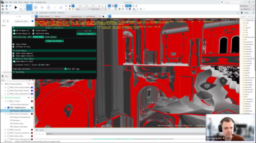
- proposes a real-time lighting system for procedurally generated isometric 2D terrains that simulates 3D lighting
- estimates the geometric shape of 2D objects to produce a 2.5D visual effect using a coupled CPU and GPU approach
- utilizes opacity maps to resolve geometry estimation artifacts
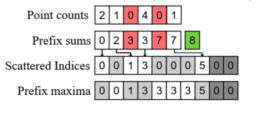
- introduces a stochastic method for rendering Gaussian Splatting scenes
- bypasses traditional sorting and tile-based rendering bottlenecks using atomics and stochastic transparency
- video discusses the technical details of the Glacier Engine
- details the real-time GI system, combining screen-space scattering with software-traced DDGI probes
- introduces a custom volumetric system leveraging OpenVDB for dynamic, self-shadowing smoke and fire effects
- explores the engine’s entity-component framework and async compute-heavy frame graph (they use up to 8 queues on PS5)
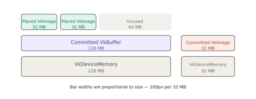
- details AnKi’s transition from a “committed” resource model to a “placed” architecture
- describes the use of a Two-Level Segregated Fit (TLSF) allocator for persistent pools and linear allocators for transient frame data
- provides a comparative analysis between mobile and desktop GPUs, highlighting memory savings and streaming improvements
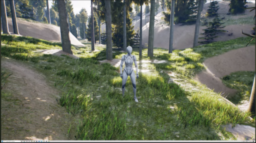
- demonstrates how to leverage the Landscape Layer Painter node within a PCG graph to automatically apply landscape layers beneath procedurally spawned tree instances
- shows techniques for generating procedural masks based on tree base locations to ensure accurate material transitions where assets intersect the terrain
- integrates Runtime Virtual Textures (RVT) to sample landscape data into tree trunk materials for a seamless visual transition between meshes and the landscape
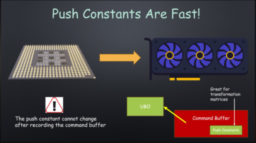
- introduces push constants as a fast, low-overhead mechanism to pass small amounts of per-draw data directly to shaders
- demonstrates the implementation of a single large texture array that stores all scene materials for efficient global access
- explains using push constant values to index into the texture array, enabling per-object material selection without frequent descriptor rebinding
Thanks to Nathan Reed for support of this series.
Would you like to see your name here too? Become a Patreon of this series.
