- introduces a scene-specific neural render proxy that enables differentiable relighting of static scenes
- decouples path sampling from emission computation by collecting light-agnostic transport samples and training a lightweight network to map them to pixel outputs
- allows scaling with resolution and light complexity rather than scene complexity
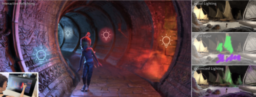
- proposes adjustable k-d tree subdivision for path guiding based on illumination variation instead of uniform sample counts
- introduces lookahead cells storing compact radiance signatures and probabilistic split criteria to detect when light fields differ enough to merit further subdivision
- improves resource allocation by refining guides in rapidly varying regions while keeping larger cells where lighting is uniform
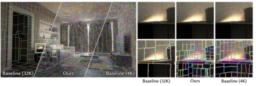
- introduces a bandwidth-optimized wide BVH representation that merges internal and leaf nodes into compact blocks for hardware ray tracing
- reformulates the surface area heuristic to estimate memory movement cost directly
- prioritizing lower data traffic over compute-centric traversal cost
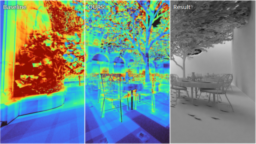
- introduces Slughorn, an MIT-licensed open-source C++20 library for Slug-style GPU curve rendering beyond text
- positions the project as a renderer-agnostic adaptation layer for vector content above APIs

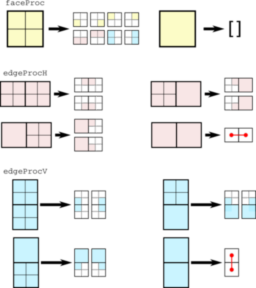
- proposes a implicit-surface meshing pipeline that separates feature-aware point generation from manifold mesh construction
- uses dual-contouring-style QEF points, binary search surface samples, and incremental tetrahedralization to guarantee manifold, non-self-intersecting geometry
- proposes a flexible framework for adding sharp-feature detection, thin-feature sampling, and hybrid surface point injection
- outlines a learning path for real-time graphics engineers
- recommends starting with simpler engines or APIs, building a path tracer, and learning PBR math
- emphasizes C++, industry norm shader languages hlsl/glsl, and using machine learning as a supporting tool
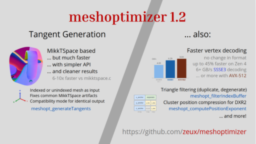
- announces meshoptimizer v1.2 with a new tangent frame generator, faster vertex decoding, and improved meshlet and cluster workflows
- adds MikkTSpace-style tangent generation, degenerate/duplicate triangle filtering, and support for the upcoming DXR2 Compressed1 format
- explains how Slang compiles to HLSL, SPIR-V, GLSL, CUDA, and CPU code while providing built-in automatic differentiation for trainable graphics functions
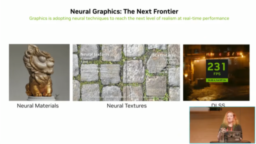
- highlights practical neural graphics use cases like neural texture mipmap optimization for non-linear data
- covers MaterialX history from its 2012 ILM launch through open source in 2017, ASWF adoption in 2021, and USD default-status in 2023
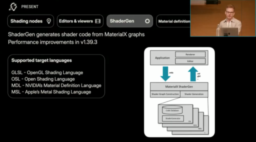
- highlights node graph standardization, shader translation across Open PBR/Standard Surface/USD Preview Surface, ShaderGen backends for GLSL/OSL/MDL/MSL, and future WebGPU and RenderMan support
Thanks to Eric Haines for support of this series.
Would you like to see your name here too? Become a Patreon of this series.
