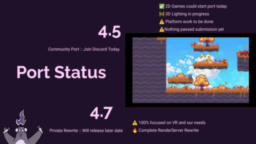
- a detailed write-up of a talk at Develop Brighton 2026 about Godot VR development
- discusses rebuilding major engine parts like the label system and render server to meet console performance needs
- details the challenges of porting Godot to PS5/PSVR2
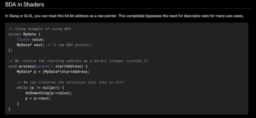
- an introductory guide to a new tutorial series on high-performance general-purpose GPU programming
- covers advanced topics such as memory consistency, subgroup operations, and GPU-driven pipelines
- aims to help developers build complex GPU-resident data structures like BVHs that minimize CPU interaction
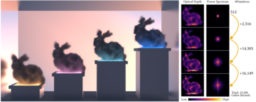
- presents Gabor Fields, a volumetric representation using anisotropic Gabor kernels instead of plain Gaussians
- enables continuous runtime LOD and orientation-selective masking for faster volume rendering
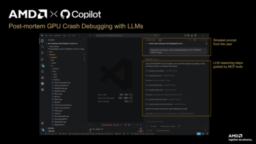
- introduces the AMD Radeon GPU Detective (RGD) MCP Server for automated crash analysis
- allows LLMs to correlate low-level GPU state with high-level application source code
- demonstrates a workflow where a single prompt can identify root causes like use-after-free errors
- highlights the debut of the SIGGRAPH Games Summit, a dedicated day of programming covering player experience, audio, rendering technologies, and production pipelines
- includes a detailed roadmap for developers, featuring sessions on real-time performance capture and engine development insights
- encourages exploration into AI-driven world models, OpenUSD adoption, and controllable generative graphics for interactive experiences
- the schedule for the 2026 edition of the course at SIGGRAPH 2026 has been released
- covering topics like PSSR on PS5 Pro and path tracing with ORCA
- the course aims to share production-proven rendering techniques from major developments
- provide a convenient schedule builder for the SIGGRAPH 2026 Technical Papers
- covers sessions ranging from 3D Gaussian Splatting and Real-Time Rendering to Fabrication and VR
- includes links to individual paper abstracts and options to add sessions to a personal calendar

- Khronos Group announces the dates and location for Vulkanised 2027 and the Real-Time Shading Symposium 2027
- both events will be held in Kortrijk, Belgium, in February 2027
- calls for submissions are now open for both conferences

- introduces a method for lighting-consistent object transfer across radiance fields using 3D Gaussian Splatting (3DGS)
- leverages diffusion models as illumination priors to synthesize realistic shadows and reflections that match the target scene
- employs a multi-view consolidation step via post-optimization of Gaussian colors to ensure spatial and temporal consistency

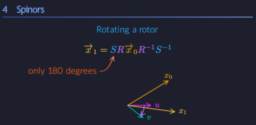
- provides a comprehensive overview of versors, rotors, and spinors, explaining how they unify geometric transformations
- explains versors as geometric products of vectors and rotors as specific versors representing rotations via the sandwich product
[video] After the Tutorial: Where to Continue your Graphics Programming Journey - Mike Shah GPC 2025
- providing a roadmap for graphics programmers transitioning from basic tutorials to building professional-grade engines
- advocates for building robust pipeline abstractions, data-driven design using external and structured scene management
- emphasizes the importance of performance optimization and using tools like RenderDoc for deep debugging
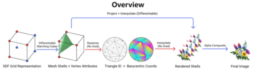
- introduces a differentiable mesh rendering framework using nested mesh shells
- enables reconstruction of large-scale, unbounded scenes using off-the-shelf triangle rasterizers
- uses differentiable marching cubes to extract shells from a signed distance function with vertex opacities
Thanks to Aras Pranckevičius for support of this series.
Would you like to see your name here too? Become a Patreon of this series.
