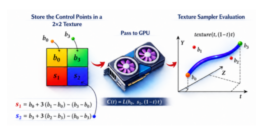
- presents a texture-based method for evaluating Bezier curves by leveraging hardware samplers
- extends the idea beyond curves to surfaces, volumes, and related spline families
- compares accuracy and performance against shader-polynomial evaluation
- conversation on lighting and shadow techniques based around it being a series of informed trade-offs
- contrasts physically based path tracing with real-time approximations, while walking through the technique developments
- explains practical shadow artifacts such as acne and Peter Panning, and discusses mitigation strategies
- additionally presents learning resources for aspiring graphics programmers
- highlights updates on Apple platforms, including Vulkan 1.4 feature exposure and performance improvements
- adds validation and tooling upgrades such as scoped GPU-assisted validation, GPU Dump, and support for 13 new Vulkan extensions
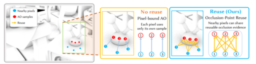
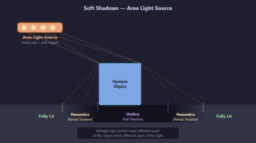
- introduces an occlusion-point reuse framework for ray-traced ambient occlusion and area-light shadows
- reformulates estimators in occluder space and combines neighboring samples with multiple-importance-sampling
- curated link collection for SIGGRAPH 2026
- aggregates key external resources, including Real-Time Live, Vulkan and neural shading course pages, and research project links

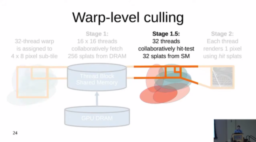
- presents warp-level culling for 3D Gaussian Splatting by mapping thread warps to 4x8 subtiles and collaboratively rejecting non-contributing splats
- combines sub-tile culling with tuned batch sizes and shared-memory optimizations
- introduces neural.slang as a standard Slang module for running tiny neural-network evaluations inline in shaders
- shows shared logic across CUDA, Vulkan, and Metal via packed subgroup matrix-vector techniques
- includes benchmarks against CUDA kernels and ML frameworks

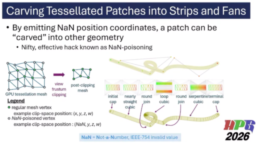
- introduces Waro, a 2D vector graphics library that uses tessellation and mesh-shader pipelines
- uses a compact baked path representation so that the fill policy details can be resolved efficiently at runtime
- details a homogeneous path-link/control-point layout and an uber-shader workflow (including stencil-based winding evaluation)
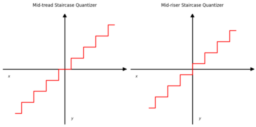
- examines the common 8-bit normalization choices
x/255versus(x+0.5)/256through quantization behavior and error analysis - explains why dividing by 255 remains the correct default for processing images and preserving expected conventions
- notes that the 256-based variant can be useful in tightly controlled encode/decode pipelines, but mixing models leads to avoidable bias
- presents an introduction to opacity micromaps (VK_KHR_opacity_micromap) as a way to accelerate ray-traced shadows for alpha-tested geometry
- describes pre-baking per-microtriangle opacity states into acceleration structures to reduce expensive any-hit shader invocations
- outlines a tutorial path covering the shadowing problem, micromap formats, and integration into a sample Vulkan application
Thanks to Nia Bickford for support of this series.
Would you like to see your name here too? Become a Patreon of this series.
