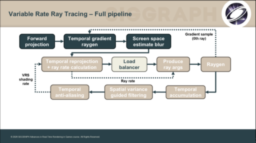
- presents a system for reallocating rays more efficiently
- built around supersampling where temporal history is missing, undersampling with temporal reconstruction in stable areas, and a load balancer to keep a fixed ray budget
- provides a discussion of the basics
- discusses implementation details such as reprojecting the random-sequence index, per-texel rejection weights, and bucket-based load balancing
- SIGGRAPH 2026 Advances talk on adaptive tessellation and Catmull-Clark subdivision surfaces
- introduces clamped parallelogram tessellation as an alternative to hardware tessellation
- Describes a compute-based adaptive tessellation pipeline with a feature-adaptive Catmull-Clark evaluator that uses analytic patches
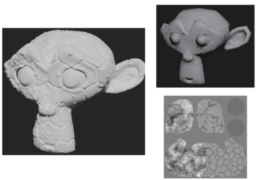
- covers the upgrade process to PlayStation Spectral Super Resolution since the initial release
- explains the limitations of the launch Color Predicting Network approach
- presents the advantages of Kernel Predicting Network in terms of quality and training process
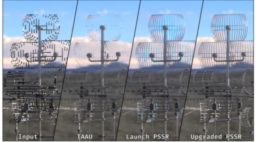
- follows a single global-load instruction on an RTX 4090 through the full memory hierarchy, from warp registers to RAM
- explains the internal mechanics of each stage, including address translation, L1/L2 set indexing, and row activation
- includes simulation of memory traffic timings
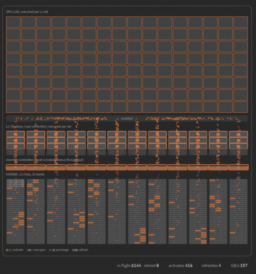
- announces a new release of AMD’s open-source library for GPU-accelerated Multi-Layer Perceptron (MLP) inference and training on D3D12
- migrates from Cooperative Vectors to the D3D12 Linear Algebra Matrix API in Shader Model 6.10
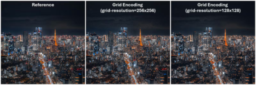
- adds input encoding for neural texture compression and a new interactive example for training to represent a texture
- full walkthrough of a procedural 2D grass renderer, which treats grass as an image generated by two compute passes each frame
- discusses the implementation that allows generation from a hash with no persistent state, using a density texture and a wind/velocity field
- covers generation, simulation, and shading
- includes a live browser demo plus the complete shader source
Thanks to Marius Horga for support of this series.
Would you like to see your name here too? Become a Patreon of this series.
