- demonstrates offscreen rendering in Vulkan as an alternative to rendering directly to the swapchain
- explains how swapchain rendering can cause additional hardware overhead that doing the lighting pass to an HDR offscreen image avoids
- covers command buffer refactorings required and integrating the submission into the render queue
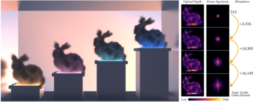
- introduces Gabor Fields as an alternative to Gaussian-based volumetric representations
- enables continuous level-of-detail by masking primitives based on frequency and orientation selectivity, avoiding re-fitting, mipmaps, or popping
- accelerates rendering with stochastic analytic line integrals and uses a low-frequency Gaussian base for further optimizations
- demonstrates how to use VK_EXT_layer_settings to configure Vulkan validation layers from code
- shows how to enable Best Practices checks and debugPrintfEXT via VkLayerSettingEXT
- includes an interactive example that triggers common validation warnings

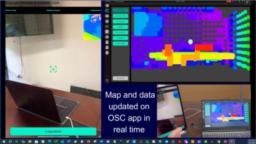
- demonstrates how to render voxel occupancy maps from SLAM (Simultaneous Localization and Mapping) data as instanced cubes in Vulkan
- additionally presents a comparison against GLTF meshes and embedded 3D Gaussian Splats
- discusses using D3D12 reserved resources to manage large persistent buffers in a GPU-driven renderer with dynamic memory requirements
- compares grow-or-shrink, static, and block-based allocation strategies
- followed by presenting a VirtualAlloc-style SparseBuffer wrapper that commits and decommits 64 KiB pages with a contiguous virtual address space
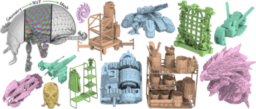
- introduces a generative method that creates compact 3D meshes from SDF inputs
- represents mesh topology as a Nearest-Vertex Vector Field (NVF) and trains a latent flow-matching model
- build the final mesh by clustering surface regions with the generated NVF and using constrained QEM simplification
- teaches how to write a first 2D fragment shader in Godot 4 by creating an animated portal effect step by step
- covers shader fundamentals such as vertex and fragment stages, UVs, uniforms, functions, texture sampling, and noise deformation
- includes practical Godot-specific topics like shader built-ins, visual debugging, and controlling shaders from GDScript

- implements Neural Texture Compression in Metal on Apple Silicon
- details the training pipeline with latent grids, quantization-aware training, Adam optimization, and inference using half-precision GEMV or M5 neural-accelerator tensor ops
- discusses stochastic trilinear interpolation for mip blending, performance benchmarks across devices, and practical limitations such as alpha testing, anisotropic filtering, and mixed material resolutions
- Introduces two Rust frontends for CUDA: cuda-oxide for SIMT programming and cutile-rs for tile-based programming
- The cuda-oxide track compiles functions to PTX through a custom rustc backend, while the cutile-rs track JIT-compiles tile kernels via CUDA Tile IR on stable Rust
- both tracks enforce memory safety at compile time through DisjointSlice and launch contracts or tensor partitioning
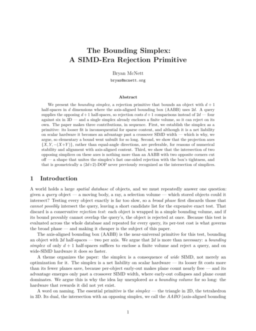
- presents the bounding simplex, a rejection primitive using d+1 half-spaces instead of the 2d half-spaces of an AABB
- argues that the simplex becomes advantageous over AABBs on wide SIMD hardware
- proposes the axis set {X,Y,-(X+Y)} for numerical stability
- introduces the AABO as the intersection of two opposing simplices
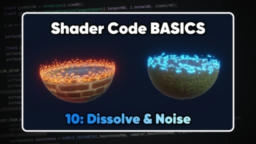
- demonstrates how to create custom dissolve effects in Unity (HLSL shader code)
- builds procedural Perlin and Voronoi noise generators from scratch
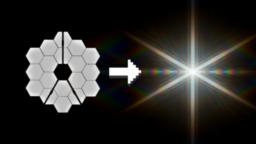
- explains the physics and mathematics behind bloom as light diffraction and dispersion through an aperture
- introduces Linear Time-Invariant systems, impulse responses, and convolution to model the response to bright point sources
- shows how Fourier transforms can approximate diffraction patterns
Thanks to Graham Wihlidal for support of this series.
Would you like to see your name here too? Become a Patreon of this series.
