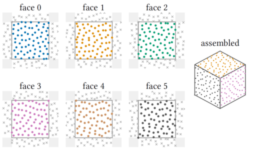
- presents a way to generate blue-noise samples that spread points evenly without forming a regular grid
- controls the pattern by adjusting which spatial frequencies are suppressed, including across areas with different target densities
- applies the method to stippling and spherical surfaces, producing patterns that stay visually consistent as point density changes
- explains why light attenuation in a volume follows an exponential curve when its particles are randomly distributed
- models each thin slice as removing a fixed fraction of the incoming light, so the remaining light is multiplied repeatedly
- shows how Euler’s number provides a convenient way to express this distance-dependent absorption in volume-rendering equations

- adapts the radiance cascades technique for 3D global illumination
- allocates sparse probes on visible surfaces and splits traced rays into distance intervals
- details hash-table probe allocation, directional radiance bins, and probe LODs for controlling memory and quality
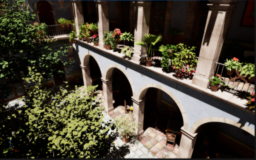
- introduces a scene-specific neural render proxy for interactive, differentiable relighting of static scenes with fixed cameras and materials
- trains a lightweight network from light-agnostic path samples to predict transport
- decoupling path sampling from emission evaluation

- announces five days of Vulkan and real-time shading talks in Kortrijk, Belgium, from February 8–12, 2027
- covers Vulkan updates, debugging tools, ray tracing, neural rendering, GPU-driven compute, and production case studies
- features Ken Perlin’s keynote and sessions on Slang, shader languages, tooling, and optimization
- early-bird registration runs through January 15

- explains albedo remapping for subsurface scattering, tracing the physics behind the mappings used in practical subsurface scattering (SSS) shaders
- compares the remapping approaches and derives how artist-facing parameters are converted into the scattering coefficients required by the model
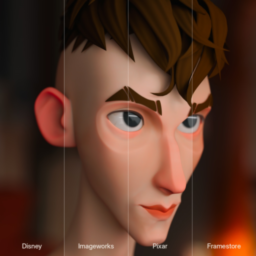
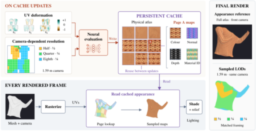
- introduces Deformable Texture Maps, a compact neural texture that maps texture coordinates and local deformation
- caches these maps in persistent texture space and selectively updates them as deformation changes
- demonstrates the representation on deforming yarn textiles, capturing changing geometry and occlusion
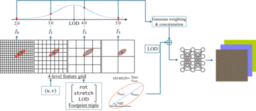
- adds anisotropic filtering directly into neural texture compression, keeping surfaces sharp up close without blurring at steep angles
- teaches the neural decoder to adjust its filtering based on pixel footprint shape, angle, and distance
- delivers quality close to full-size compressed textures while using only a quarter of the memory
- pairs up with Casey Muratori to implement and refine animation blending in a custom game engine
- fixes rotation-blending artifacts with quaternion dot products and syncs cycles of different lengths using normalized timelines
- explores an immediate-mode blending architecture that accumulates animation layers into a shared skeleton buffer

- covers fundamental quantization techniques to compress neural network weights into low-bit formats like FP8, INT8, and INT4
- explains linear quantization with scale and zero-point parameters, tuning granularity across tensors, channels, and groups
- compares post-training quantization against quantization-aware training to preserve accuracy under reduced precision
Thanks to Nathan Reed for support of this series.
Would you like to see your name here too? Become a Patreon of this series.
