- very detailed blog post that discusses the reality of modern GPU hardware
- presenting the disconnect between API models and hardware
- proposes a minimalistic modern graphics API design that reduces complexity while maintaining performance
- blog post contains an example of what such an API might look like

- announces the release of the OpenUSD Core Specification 1.0 defining formal semantics for scene descriptions
- specifies six essential pillars including grammar, composition algorithm, and compliance framework
- provides sample implementations and conformance testing tools for validating implementations

- investigates behavior of ClearUnorderedAccessViewUint and ClearUnorderedAccessViewFloat functions
- reveals inconsistent type conversions across NVIDIA, AMD, and Intel GPUs for various buffer formats
- demonstrates that unsigned integer clears work differently than documented in DirectX 11
- continues the series with practical solutions and sample patterns for real-time renderers
- shows shader-level techniques (sample distributions, MSAA-aware approaches) and links to Shadertoy experiments for direct testing
- covers trade-offs between artifact reduction and performance, with suggestions that are implementable in real-time
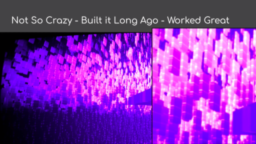
- introduces an MLIR-based intermediate representation for CUDA kernel targeting tensor cores
- provides domain-specific operations for tile-based computations with Python bindings
- includes bytecode serialization format
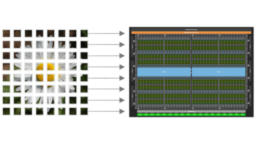
- presents a novel representation combining surfels with neural texturing for view synthesis
- achieves quality matching 3D Gaussian splatting using 9.7x fewer primitives on outdoor scenes
- aims to improve render times compared to existing methods by selectively texturing high-weight samples
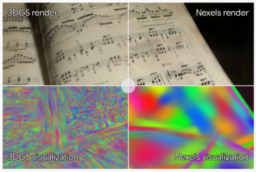
- walkthrough of parallax occlusion mapping (POM) techniques for Unity
- integrating Nanite displacement for terrain rendering and how Nanite displacement changes displacement workflows
- discusses performance implications and offers tips for balancing quality vs cost in terrain shaders
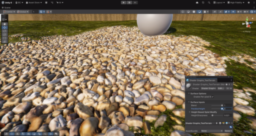
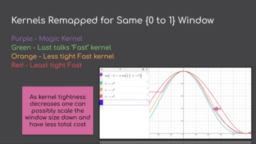
- short talk focused on micro-optimizations to the filter kernel and their real-world impact
- examines kernel tweaks that reduce aliasing artifacts while keeping shader cost low
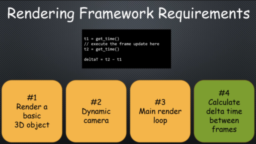
- sets up an initial physics framework and demonstrates simple particle dynamics
- walks through application/physics system classes and a short demo showcasing the physics update
- rendering is implmeneted using OpenGL
- live stream focused on making scene loading faster by caching optimized geometry on disk and adding compression
- walks through implementing a basic scene cache, switching to memory-mapped loading, adding compression, and profiling cold/hot runs and page-fault behaviour
- practical andf focused session with profiling runs, implementation details and trade-offs for robust cache/IO design
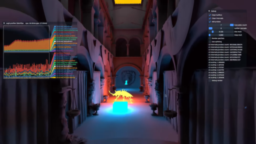
- presents the results of replacing the screenspace raymarcher implementation with a hardware-accelerated raytracer enabling offscreen lights and more stable GI
- achieves real-time per-frame GI (no denoiser) on a 4090
Thanks to Aras Pranckevicius for support of this series.
Would you like to see your name here too? Become a Patreon of this series.
