- presents image blurring techniques from 2D box blur to separable Gaussian and dual-filter techniques
- explains how separable convolution, bilinear sampling, and down/up-sampling reduce the workload
- compares the quality and speed trade-offs
- presents a shader tutorial on adjusting animation speed
- covers timing controls and interpolation
- includes an interactive example to experiment with the code
- introduces version 1.3 of meshoptimizer
- adds an experimental voxel remesher, automatic normal generation, and new simplification options
- stabilizes permissive simplification and improves decode, meshlet, and cluster-LOD performance
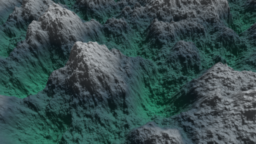
- extends the Godot procedural GPU patterns series by adding derivatives to value noise
- derives smooth and smoother blending functions for continuous first- and second-order derivatives
- shows how to use it for normals and vertex displacement
- introduces ADLX 2.0 with AI extensions for AMD graphics hardware control
- provides Python bindings and Model Context Protocol (MCP) servers for AI-agent integration
- enables applications to query GPU telemetry, change settings, and tune performance

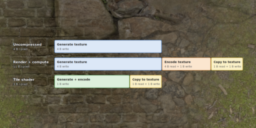
- shows how Spark codecs can encode render targets directly from Metal tile memory
- presents a tile-shader setup using a memoryless RGBA8 attachment and one thread per 4x4 block
- reports performance results compared against separate compute passes
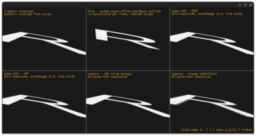
- compares GPU text-rendering methods such as SDF, MSDF, tessellation, and Slug
- explains the Slug method of working directly from Bézier outlines in the fragment shader with no atlas
- presents a Vulkan reimplementation of NVIDIA’s DLSS 5 Neural Rendering network
- reproduces the same 71-block Swin/ViT architecture and is bit-exact against the original
- includes GLSL and PTX kernels and a browser-based WebGPU port
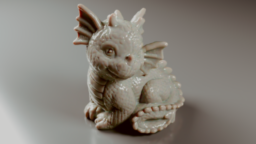
- discusses subsurface scattering driven by a blue-noise distribution
- explains that classical exponential light transport breaks down in this scenario
- introduces a super-exponential light-transport model
Thanks to Nia Bickford for support of this series.
Would you like to see your name here too? Become a Patreon of this series.
