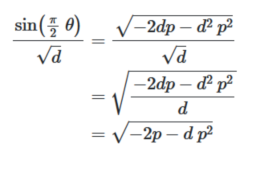
- presents specialized SIMD-friendly log and exp functions for unit quaternions
- achieves error bounds comparable to standard-library implementations while avoiding full-turn angle ambiguity
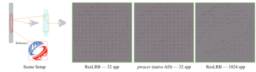
- introduces Reservoir Light Replay Backpropagation (ResLRB) for reverse-mode differentiable light tracing
- compresses the adjoint graph during the primal pass with a streaming weighted reservoir
- yields an unbiased gradient estimator whose peak memory is independent of path length
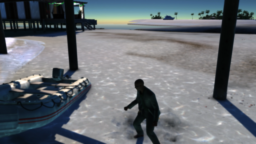
- analyzes a frame of Hitman World of Assassination
- covers G-buffer generation, tiled deferred lighting, cascaded shadows, screen-space ambient occlusion/reflections, volumetric fog and post-processing
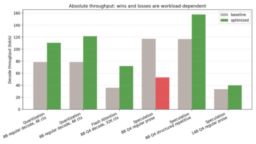
- maps GPU optimization instincts from graphics to large-language-model inference
- benchmarks Qwen3 models on an RTX 3090 across quantization, Flash Attention, KV-cache compression and speculative decoding
- shows optimization targeting the different bottlenecks
- provides a self-study roadmap for learning graphics programming from free online resources
- recommends C++, CMake, SDL alongside linear algebra, projective geometry and data structures
- summarizes recent WebGPU and WGSL additions shipping in Chrome 155-156
- highlights the fragment_depth extension, unaligned compressed textures, new linear color spaces and the snorm10-10-10-2 vertex format

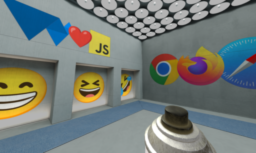
- introduces the upcoming bindless texture sampling support in WebGPU via GPUResourceTable
- demonstrates a projected-decal emoji demo
- compares bindless allocation against texture-array fallbacks and notes future heterogeneous resource tables
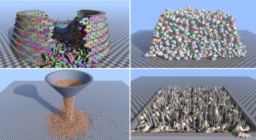
- presents a real-time collision-detection framework for SDF-encoded geometry
- combines temporal coherence caching with curvature-guided importance sampling to form sparse contact manifolds
- runs complex scenes with thousands of rigid bodies
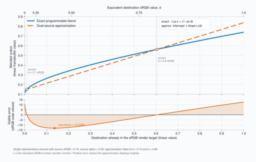
- explains Metal dual-source blending, where a fragment shader emits a primary and secondary color for the blend unit
- walks through using the technique to approximate sRGB-correct blending for Dear ImGui
- concludes that programmable blending provides a more exact match on supported Apple Silicon GPUs
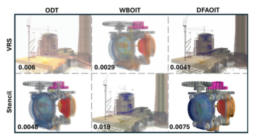
- presents a plug-in acceleration suite for order-independent transparency
- exploits spatial and temporal coherence through adaptive tiled sampling or variable-rate shading plus temporal reprojection
- covers the development of a custom 2D lighting system in Unity for the cyberpunk game Glitch Hunt
- applies data-oriented design principles to support hundreds of concurrent dynamic lights with minimal CPU overhead
- details hand-drawn specular and bloom maps alongside reactive fog and rain systems
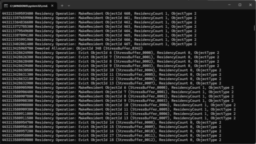
- releases DxTimingCaptureLibrary, an open-source C++ helper for DirectX ETW events
- exposes GPU timings, object lifetime, residency/paging, DirectStorage, pipeline compiles and PIX markers
- provides samples for console logging, Perfetto tracing, D3D12 journal entries and memory visualization
- updates meshoptimizer support for hierarchical clustered LOD using NVIDIA’s vk_lod_clusters sample
- discusses meshopt compression, simplification improvements, error clamping and a new meshlet topology codec
- shows the Zorah scene processing pipeline and foliage area-preservation heuristics

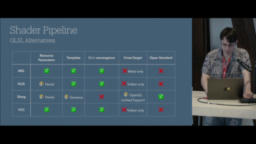
- explains how Blender’s move from OpenGL to Vulkan and Metal exposed shader portability, compilation-time and legacy GLSL maintenance challenges
- introduces Blender Shading Language (BSL), a C++ subset for sharing code between CPU and GPU
- outlines plans to migrate more legacy shaders, expand C++ syntax support and consider binary formats as graphics standards evolve
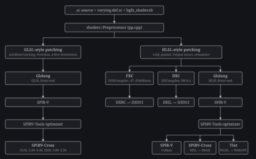
- explains how bgfx’s shaderc translates a GLSL dialect to many backend languages without its own AST
- relies on the C preprocessor, textual patching and real target compilers such as FXC, DXC, Glslang and Tint
- compares the approach with modern alternatives
- presents a method that combines standard triangle mesh representations with per-pixel local raymarching to render displacement maps, volumetric effects, and self-shadowing on bone-animated meshes
- preserves exisitng workflows and fallback to normal mapping
Thanks to Nia Bickford for support of this series.
Would you like to see your name here too? Become a Patreon of this series.
