- walks through building a render graph from scratch based on resource access timelines
- explains two-level command recording, consecutive read and concurrent-write access grouping, pass batching, pass reordering, and transient memory aliasing
- includes discussions on memory usage and GPU time savings
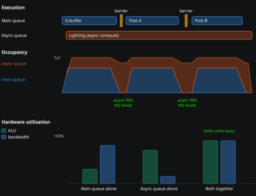
Siggraph 2026: smolder real-time volumetric effect rendering in glacier & 007 first light (Advances)
- presents Smolder, a real-time volumetric effect rendering framework
- uses Moment-based Order Independent Transparency (MBI) for shadows and transmittance
- custom OpenVDB-based runtime density format integrated with lighting and volumetric fog
- presents how cross-target hardware scaling is approached
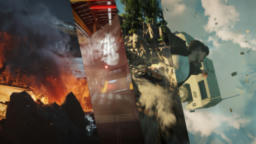
- details the evolution of the voxel terrain renderer from a mesh-based and visibility-buffer pipeline to a sparse SDF brick renderer
- describes the brick structure (54x14x54 sparse octrees of 6x6x6 SDF and material bricks with GPU feedback streaming, tight brick bounds, and jumpflood SDF generation in LDS) used for sphere-traced visibility, DDA ray tracing, and detail scattering
- presents the results, performance, and memory savings
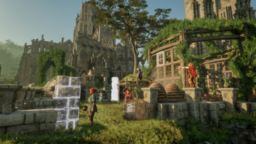
- analyzes a late-game Timberborn frame in RenderDoc and Radeon GPU Profiler
- documents the Unity frame structure
- detects that most of the cost is from GPU idle time, with large gaps between 8k shadow draws and 11k non-instanced opaque draws

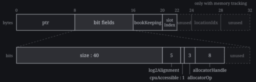
- presents bx::Blk, a 24-byte non-copyable block handle storing a 64-bit pointer or GPU offset, size, alignment, last operation, and an 8-bit allocator handle
- unifies CPU and GPU sub-allocation by keeping allocator bookkeeping inside the block rather than memory headers
- presents how multiple allocators can be used to manage VkDeviceMemory or ID3D12Heaps
- derives ratio tracking from scratch as an unbiased Monte Carlo estimator for volumetric transmittance
- resolves the high variance of alternating Taylor series by introducing a majorant upper bound to shift into a non-negative exponential series weighted by a Poisson distribution
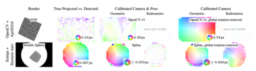
- proposes a radiometric camera model that lifts any central geometric camera model by adding a finite aperture, a free-form focus surface, and a vignetting function
- calibrates parameters via inverse rendering directly on sensor-relative irradiance from standard calibration target images without feature detection
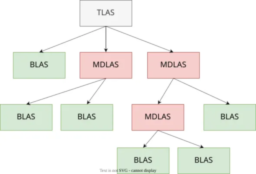
- introduces the experimental VK_AMDX_multi_level_acceleration_structure extension shipped in Vulkan 1.4.369
- adds up to two extra instance levels to the ray-tracing acceleration structure hierarchy to avoid unrolling bottom-level instances and duplicating rigidly animated geometry
- targets lower acceleration structure build and update costs while reducing memory usage
- announces LunarG sponsorship and technical sessions at Vulkanised 2027 and the Real-Time Shading Symposium
- covers talks on VK_KHR_descriptor_heap, VK_KHR_shader_object, VK_KHR_shader_abort, SyncVal 2027 synchronization validation, and more
- includes a symposium session on SPIR-V Integrated Tester for validating ShaderDebugInfo in SPIR-V

- explains row-major versus column-major matrix memory layouts
- shows the difference between column-vector and row-vector multiplication conventions
- explains how Vulkan itself is layout-agnostic and that apparent matrix flips originate from differences in viewport and projection
- lists symptoms for common bugs: transposed matrices warping or freezing translation, inverted Y projection flipping the scene, and depth-range mismatches causing clipping

Thanks to Nathan Reed for support of this series.
Would you like to see your name here too? Become a Patreon of this series.
